Health Surveillance: Protecting Your Workforce Before Problems Become Permanent

Health Surveillance: Protecting Your Workforce Before Problems Become Permanent

Health surveillance is often talked about as a compliance exercise – something employers do simply to tick a legal box. At David Barber Occupational Health, we see it differently.

Done well, health surveillance is one of the most effective tools an employer has for identifying the early signs of work-related ill health before they become long-term problems for an employee or a costly issue for the business.

More importantly, it gives employers confidence that the measures they have put in place to protect their workforce are actually working.

Did you know? Health surveillance can identify the early signs of occupational illness before symptoms become serious, enabling employers to take action sooner, protect their employees and reduce the likelihood of permanent health conditions developing.

The Health and Safety Executive (HSE) recognises health surveillance as an important part of managing workplace health risks. When combined with a suitable workplace risk assessment, it enables employers to detect work-related ill health at an early stage, review existing control measures and continually improve workplace safety.

Many occupational illnesses develop gradually. Employees often continue working without realising there is a problem until the damage has already been done. Regular health surveillance provides employers with an opportunity to identify those early warning signs, intervene promptly and help prevent long-term health conditions from developing.

What is Health Surveillance?

Health surveillance is a programme of regular employee health checks carried out over time. It is only introduced once a suitable workplace health and safety risk assessment has identified a health hazard.

It is not a substitute for carrying out a risk assessment. Instead, it provides evidence that the control measures you have already introduced are effective in protecting your employees.

For example, engineering controls, local exhaust ventilation, safe systems of work and personal protective equipment (PPE) may significantly reduce exposure to hazardous substances, excessive noise or vibration, but they cannot always eliminate the risk completely. Health surveillance monitors employees over time to identify whether those controls continue to provide adequate protection.

Health surveillance may be required where employees are exposed to:

  • Excessive noise
  • Hand-arm vibration
  • Dust, fumes or chemicals
  • Hazardous substances
  • Skin sensitisers and irritants
  • Other workplace health hazards identified through a suitable risk assessment

If your business exposes employees to any of these hazards, the Health and Safety Executive (HSE) expects employers to reduce the risks as far as is reasonably practicable.

Under the Control of Substances Hazardous to Health (COSHH) Regulations, employers have a legal duty to prevent or adequately control exposure to hazardous substances. Where a residual risk remains after control measures have been implemented, health surveillance may also be required to monitor employee health and demonstrate that those controls continue to be effective.

Health surveillance is therefore not simply a legal obligation—it is an important part of protecting your workforce while providing evidence that your health and safety arrangements are working as intended.

Why Prevention Matters More Than Compliance

A compliance-only mindset treats health surveillance as another administrative task.

A prevention mindset sees it as an early warning system.

The difference is significant.

Identifying a gradual decline in hearing, early symptoms of occupational asthma, signs of Hand-Arm Vibration Syndrome (HAVS) or work-related dermatitis before they become severe allows employers to act quickly. This may involve reviewing working practices, improving engineering controls, replacing equipment, providing additional training or introducing more effective personal protective equipment.

Early intervention can prevent long-term ill health, reduce sickness absence and help employees remain healthy and productive throughout their working lives.

It also provides valuable information about whether your existing control measures are delivering the level of protection you intended. If health surveillance identifies emerging trends across a workforce, employers can investigate the cause before more employees are affected.

Rather than simply demonstrating compliance, health surveillance becomes a valuable management tool that supports continual improvement throughout the business.

What Happens If Health Surveillance Is Ignored?

Occupational illnesses rarely happen overnight.

Unlike an accident, where the effects are immediate, many work-related health conditions develop slowly over months or even years. Employees may not notice the early symptoms, or they may assume they are simply part of getting older or working in a physically demanding job.

Conditions such as noise-induced hearing loss, occupational asthma, occupational dermatitis and Hand-Arm Vibration Syndrome (HAVS) often progress gradually. By the time symptoms become obvious, the damage may already be permanent and, in some cases, irreversible.

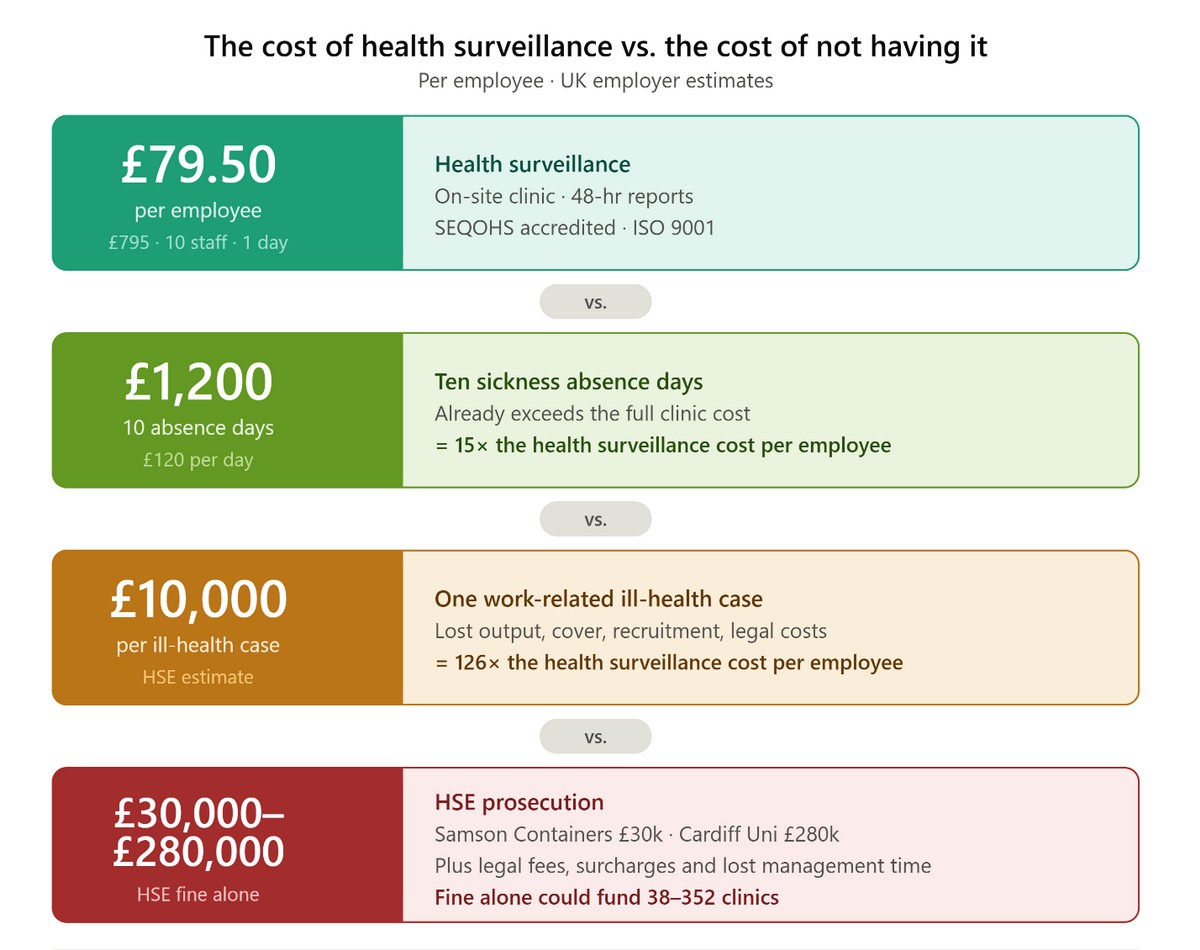
Without appropriate health surveillance, employers may not realise that existing workplace controls are no longer effective until employees begin reporting symptoms, taking sickness absence or submitting compensation claims.

The Health and Safety Executive (HSE) estimates that hundreds of thousands of workers in Great Britain suffer from work-related ill health every year, resulting in significant personal, operational and financial consequences for employers. Many of these conditions can be reduced or better managed through effective risk management, appropriate workplace controls and timely health surveillance.

Ignoring health surveillance where it is required can increase the risk of:

  • Employees developing preventable occupational illnesses.
  • Increased sickness absence and reduced productivity.
  • Higher insurance premiums and compensation claims.
  • HSE investigations or enforcement action.
  • Damage to your organisation's reputation.
  • Losing experienced employees through avoidable ill health.

Ultimately, health surveillance is about protecting people.

When employers monitor employee health proactively, they are far more likely to identify potential problems before they become life-changing conditions for individuals or significant risks for the business.

What Does Health Surveillance Involve?

Every workplace is different, which means every health surveillance programme should be based on the specific risks identified within your organisation. There is no "one-size-fits-all" approach.

Following a suitable risk assessment, your occupational health provider will recommend the most appropriate health surveillance programme for your employees. The aim is not simply to collect health data but to monitor trends over time, identify any early signs of work-related ill health and confirm that your existing workplace controls continue to protect your workforce.

At David Barber Occupational Health, our on-site health surveillance clinics can include:

  • Audiometry – Hearing assessments for employees exposed to workplace noise.
  • Spirometry – Lung function testing for employees exposed to dusts, fumes and respiratory hazards.
  • Hand-Arm Vibration Syndrome (HAVS) Screening – Monitoring employees who regularly use vibrating tools or equipment.
  • Skin Assessments – Identifying early signs of occupational dermatitis and other work-related skin conditions.
  • Vision Screening – Where visual standards form part of a role or specific workplace risks have been identified.
  • Urinalysis – Where appropriate as part of a wider occupational health assessment.
  • Regular Health Monitoring Programmes – Ongoing surveillance tailored to your business and workforce.

Wherever possible, our clinics are delivered on-site to minimise disruption to your operations. Employees can attend appointments during the working day, helping to improve participation while reducing downtime and travel.

Why Health Surveillance Matters for Your Business

Many employers understandably think of health surveillance as something they have to do because legislation requires it.

In reality, its greatest value lies in the information it provides.

Regular monitoring allows employers to identify patterns that may indicate workplace controls need reviewing. It provides reassurance when existing measures are working well and highlights opportunities to improve them before employees suffer lasting harm.

An effective health surveillance programme can help your business:

  • Identify the early signs of work-related ill health before conditions become serious.
  • Assess whether existing workplace controls remain effective.
  • Demonstrate compliance with HSE guidance and relevant legislation, including COSHH.
  • Provide an auditable record of employee health monitoring.
  • Give employees a confidential opportunity to discuss health concerns relating to their work.
  • Reduce long-term sickness absence through earlier intervention.
  • Lower the risk of civil claims and enforcement action.
  • Protect productivity by helping employees remain healthy at work.
  • Reinforce a positive health and safety culture across your organisation.

For many organisations, health surveillance also provides valuable evidence during audits, inspections and quality assurance processes, demonstrating that employee health is being actively monitored rather than simply assumed.

Health Surveillance Shouldn't End After Recruitment

Many employers focus on pre-employment medical assessments but overlook the importance of ongoing monitoring.

Health surveillance should begin when an employee starts working in a role where occupational health risks have been identified and continue at appropriate intervals throughout their employment.

Regular reviews become particularly important when:

  • New machinery or equipment is introduced.
  • Employees move into different roles.
  • Working practices change.
  • New substances are used.
  • Exposure levels increase.
  • Existing controls are modified.

By reviewing employee health alongside workplace risks, employers can respond proactively to changing circumstances rather than reacting once problems have developed.

Why Choose a SEQOHS Accredited Occupational Health Provider?

When selecting an occupational health provider, employers need confidence that the advice and services they receive meet recognised professional standards

David Barber Occupational Health is proud to be a SEQOHS (Safe Effective Quality Occupational Health Service) accredited provider.

SEQOHS is the nationally recognised quality accreditation scheme for occupational health services. It provides independent assurance that providers meet rigorous standards for clinical governance, quality management, information governance, patient care and continual improvement.

For employers, choosing a SEQOHS accredited provider means you can be confident that your occupational health services are delivered consistently, professionally and in accordance with recognised best practice.

It also demonstrates your commitment to working with an occupational health provider whose standards have been independently assessed and recognised.

How David Barber Occupational Health Can Help

At David Barber Occupational Health, we believe health surveillance should do more than help organisations meet their legal obligations.

It should help employers create healthier, safer workplaces where employees are protected, risks are effectively managed and occupational illness is identified before it becomes life-changing.

We provide tailored health surveillance programmes for organisations across Derby, Derbyshire and the Midlands, working with businesses of all sizes and across a wide range of industries.

Our experienced occupational health clinicians deliver professional on-site clinics, provide clear, confidential reporting and maintain secure, auditable employee health records to help support your ongoing compliance and workforce wellbeing.

Whether you are introducing health surveillance for the first time or reviewing an existing programme, we will work with you to ensure your employees receive the right monitoring based on the risks they face—not simply a standard package.

About David Barber Occupational Health

David Barber Occupational Health is a SEQOHS accredited occupational health provider, supporting organisations throughout Derby, Derbyshire and the Midlands with practical occupational health services that help protect employees and support healthier workplaces.

Our services include health surveillance, workplace vaccinations, management referrals, pre-placement assessments, wellbeing support and a range of occupational health solutions tailored to the needs of employers across both the public and private sectors.

We believe occupational health should be practical, proportionate and focused on helping businesses protect their people while meeting their legal responsibilities.

Protect Your Workforce with Confidence

Health surveillance is far more than a compliance exercise. It is an investment in the long-term health of your employees and the future resilience of your business.

By identifying the early signs of work-related ill health, monitoring the effectiveness of workplace controls and taking action before problems become serious, employers can create safer workplaces, reduce business risk and demonstrate a genuine commitment to employee wellbeing.

If you would like to review your current health surveillance arrangements, or discuss introducing a programme tailored to your organisation, David Barber Occupational Health is here to help. Get in touch (link to contact page)

Connect with us!
We are here for you.

If you would like to learn more about how proactive occupational health services can support your organisation, contact our team today.

Call now for consultation

01332 318978

Or request a call back

Thank you! Your submission has been received!
Oops! Something went wrong while submitting the form.